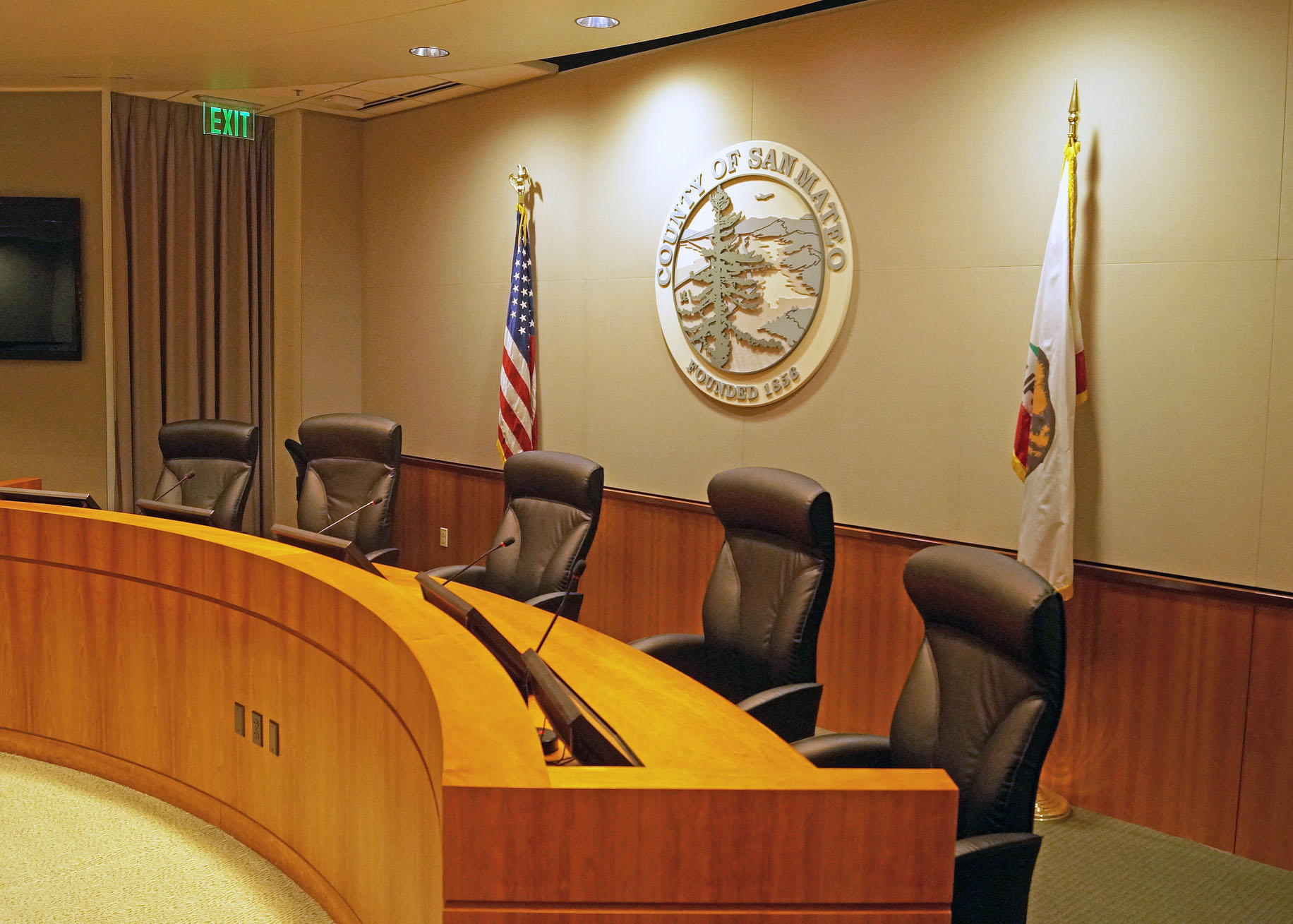
The San Mateo County Board of Supervisors on Tuesday approved new supervisorial district boundaries that will stay in effect for a decade and used the most recent numbers from the 2020 U.S. Census.
The board unanimously approved what was called the "Communities Together" proposal for the county's five districts. Two of the new ones, District 1 and District 5, will have a majority of eligible voters who are racial or ethnic minorities, while the new Districts 2 and 4 have about even numbers of white and minority voting-age residents.

"Four of the five districts provide significant opportunities for traditionally underrepresented groups to elect candidates that reflect the values of their communities," Board of Supervisors president David Canepa said. "This is a significant achievement in drawing lines that respect the makeup of our communities today."
While the new map will determine lines for the next decade, four of the five current members of the Board of Supervisors are prohibited from running for re-election due to term limits.
A 15-member Supervisorial District Lines Advisory Commission with the county had voted in October to recommend two maps to the Board of Supervisors following a series of public meetings.
"I want to thank everyone who took the time and put in the effort to get involved and to give their input," said Supervisor Don Horsley. "Ensuring we have districts that minimize divisions and empower local communities is the very essence of representative democracy."
Federal and state law requires the districts to be updated every 10 years following the release of the new Census data. They must be balanced in population, with communities of interest and cities staying intact as much as possible, among other criteria.
The board gave its initial approval Tuesday for the "Communities Together" proposal, with a final vote tabbed for Dec. 14. When approved, the boundaries will first be used in the June 2022 primary election.
The following shows the population in the approved map:
| COMMUNITIES TOGETHER: TOTAL POPULATION |
|---|
| District | 1 | 2 | 3 | 4 | 5 | Total |
| Total Pop. | 147,541 | 158,4809 | 153,827 | 153,790 | 151,779 | 765,417 |
| Deviation from ideal | -5,542 | 5,397 | 744 | 707 | -1,304 | 10,939 |
| Each of the five districts must contain about 153,083 people. |
The following shows the citizen voting age population in the approved map:
| COMMUNITIES TOGETHER: CITIZEN VOTING AGE POPULATION |
|---|
| District | 1 | 2 | 3 | 4 | 5 | Total |
| Total | 99,909 | 96,306 | 111,071 | 87,214 | 106,347 | 500,848 |
| % Hispanic | 21% | 14% | 10% | 28% | 18% | 18% |
| % Non-Hispanic White | 42% | 52% | 72% | 50% | 20% | 47% |
| % Non-Hispanic Black | 2% | 3% | 2% | 6% | 4% | 3% |
| % Asian/Pacific Islander | 35% | 30% | 15% | 15% | 57% | 31% |
Horsley said the new districts also respect the geographical integrity of local communities and neighborhoods with shared interests, known as “communities of interest," according to a county press release.
Requirements for the district include compliance with federal and state equal voting rights and the following rank-ordered state law criteria:
- Drawing districts that are, as much as possible, geographically contiguous
- Keeping communities of interest intact, as much as possible
- Keeping cities intact, as much as possible
- Having easily identifiable boundaries (major highways, railways, streets, rivers, mountains), as much as possible
- Drawing districts to encourage geographical compactness, as much as possible.
The Board on Tuesday approved an ordinance adopting the map, a move that must come back before the Board for a second reading on Dec. 14, 2021.
Pulse staffers contributed to this report.