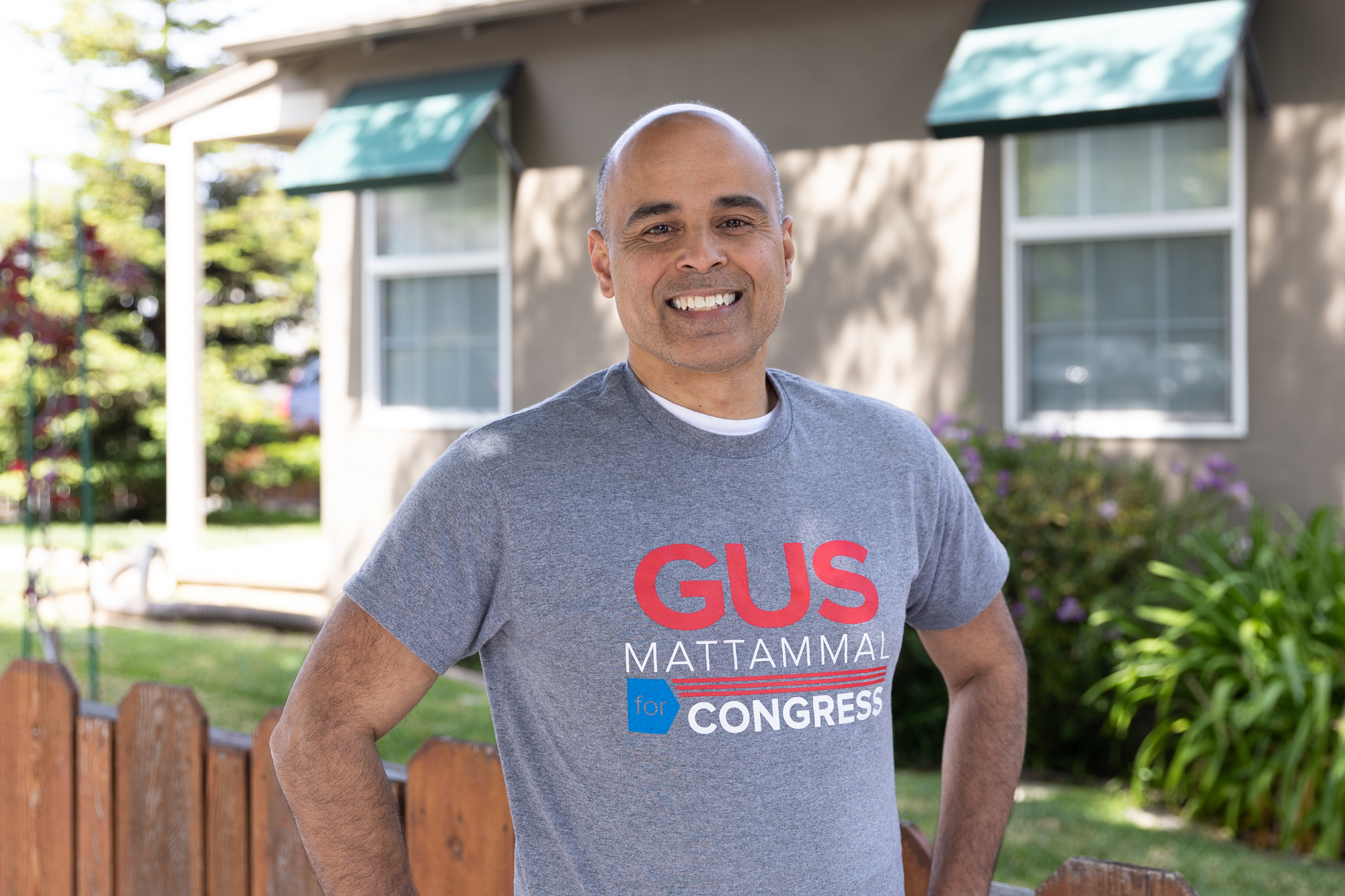
Gus Mattammal wants to challenge assumptions and defy expectations.
Yes, he is a Republican running in a Congressional district dominated by Democrats. As such, he may not be the odds-on favorite to fill a seat that has long been held by U.S. Rep. Jackie Speier.
But with a bit of luck and lots of pluck, Mattammal bucked the odds in the past as he went from a working-class upbringing in St. Louis, Missouri, to a director of a tutoring company, Advantage Testing, a company he expanded west, and under his guidance, opened six offices.
As far as politics go, Mattammal is relatively new to the party. Unlike his three primary opponents, who are all Democrats, he has not held an elective office or a job as a staffer. He's also new to the Republican Party— he joined the GOP just five days before an uprising at the U.S. Capitol made many observers and politicians question what the party stands for.
For Mattammal, 49, it means leveraging the private sector to solve public problems and tackle education reform, climate change and health care.
As a tutor, he is particularly passionate about education. His local school, Roosevelt High School, had a graduation rate of about 25% in the late 1980s, and none of his childhood friends had graduated, Mattammal said in a recent interview.
"I watched an entire generation of low-income, overwhelmingly minority kids fed into a public school that doesn't work. It fails to do what it's trying to do," Mattammal said.
However, he wants to make it clear that he does not oppose public education. Public schools, he said, are one of the things that made this country great.
"But believing in public education doesn't necessarily mean that I believe that every individual public school out there or that the system, as currently constructed, is the best public school system that we can possibly have," he said.
His primary solution is setting up educational savings accounts for lower-income individuals that would enable them to pursue other school options if their local schools are failing them. The goal, he said, is to give people more options when it comes to education. Today, individuals with higher incomes already have the option of leaving a public school system if it's not performing well. Only the lower-income families don't have that, he said. The government would play a role in subsidizing these accounts and opening up more choices.
Mattammal was more fortunate than most of his friends regarding high school education.
His grandfather, a carpenter and a plumber, and his grandfather's best friend, an electrician, remodeled the family home to rent out the bottom floor to another family. His parents saved that money and used it to send Mattammal and his three siblings to private schools. As a teenager, Mattammal attended an all-boys Jesuit school and worked 12-hour days on Sundays at a local ice cream shop, where he made $3.35 an hour. He also got his first start in tutoring when his teacher, sensing his boredom in class, charged him with tutoring two legendary class clowns, Mattammal said.
After graduating from high school, Mattammal moved to California to attend Pomona College.
Once he got his degree, he moved through many odd jobs, including a stint selling television ads and flirted with pushing a doctorate in theoretical astrophysics, a subject for which he was passionate. Instead, he went to Yale School of Management, where he earned a master's degree in international strategy and finance. He then moved to various jobs at Capital One, taking him from Richmond, Va., to New York City.
Education, however, was always on his radar. Mattammal volunteered at the nonprofit Junior Achievement, where he taught financial literacy to underprivileged children. So when an opportunity came up for him to join Advantage Tutoring, he jumped at the chance. Before long, the New York-based company moved him west so that he could open offices in Portland, Seattle, Charlotte and other cities. The company, he said, now has about two dozen offices around the country.
Mattammal, who lives in El Granada, believes his experience in education makes him well suited to pursuing the types of reforms that California needs. For years, he said, the Democratic supermajority's main answer on education has been to throw more money at the problem. Yet California's K-12 education, he observes, lags behind most states (U.S. News & World Report currently ranks it as 40th).
Mattammal has no objections to funding public education, but he believes that there should be consequences for schools that aren't getting the job done. And if government subsidies allow low-income families to leave these schools, it would carry the added benefit of lowering class sizes at these schools and making it easier for them to improve their performance. Some of the lowest-performing public schools may close, but Mattammal believes that's not bad.
His passion for personal choice extends to climate change and health care. When Mattammal talks about his support for universal health care, he is looking to Singapore. A system he envisions, modeled after Singapore's, would furnish everyone with a "universal health account" dedicated to paying for health care needs. While the government also contributes to these accounts, Mattammal believes that a Singapore-style system would significantly slash America's health care costs, give residents more choice and minimize the role of insurance companies.
"If you can control the money, we will ultimately spend less money and we wil need fewer large government programs to run this policy," Mattammal explained at an April 6 candidate forum.
"So it achieves conservative goals of spending less money, less administrative space, more personal choice and freedom," he said.
He also preaches personal choice and the free market to address climate change, an issue central to his campaign. He does not support, for example, the recent trend by local governments to mandate "electrification" — a switch from gas appliances to electric ones — to curb greenhouse gas emissions. Rather than requiring the switch, governments should create incentives such as tax breaks that would push people toward environmental sustainability, he said.
However, to really move the needle on climate change, the nation needs to invest more in technology. This includes carbon-capture technology, which absorbs carbon dioxide emissions before entering the atmosphere and storing it, usually underground. An advantage of this technology, he said, is that it can be set up in places like Wyoming and West Virginia, which have depended on fossil-fuel industries for jobs and economic growth.
"Carbon capture offers an ability to set up new industry in the places that the West has left behind," Mattammal said in an interview.
He also believes the country should invest more in nuclear fusion power, which relies on fusing nuclei of tiny atoms to create energy. Other nations, including the United Kingdom and Canada, have fusion projects in the works. The United States should not fall behind in this race, he said.
Nuclear power should also be part of the solution, he said. At the April 6 forum, Mattammal maintained that the days of Three Mile Island are "long gone," referring to a 1979 meltdown of a nuclear reactor that is considered the worst nuclear accident in American history.
"Nuclear plants are much smaller and of safer design now than they used to be. We should be building more of them," Mattammal said.
Mattammal is well aware that any Republican would face long odds in District 15, but he is undaunted by the challenge. As an immigrant's son (his father is from India) and an advocate for universal health care and strong investment in climate change, he believes that he can effectively fuse liberal ideals with conservative policy preferences. He sees himself as a political moderate, and he said his decision to join the Republican party was largely driven by his sense of where his views would carry the most significance.
"I could theoretically make my home in a center-left or a healthy center-right party, whichever one needs the most help," Mattammal said. "I felt the Republican Party needs my help. I want to help it be the best it can be because I think a constructive conservative would add an important voice to the national conversation."
If elected, he believes he can do something that no other candidate in the race can: bring the Republican Party to the table to pass the necessary legislation. He has already secured endorsements from the state GOP and the Republican chapters in San Mateo County and San Francisco. At an April 20 forum sponsored by Thrive, a coalition of nonprofits, he made the case that as a Republican, he would be able to effectively represent the Peninsula, mainly if the party takes over the House majority after the midterm elections, as is widely predicted.
"If you want to make real progress on issues like voting rights, like immigration, of the five of us only I can deliver the thing that we most need: support from the Republican Party," Mattammal said.