
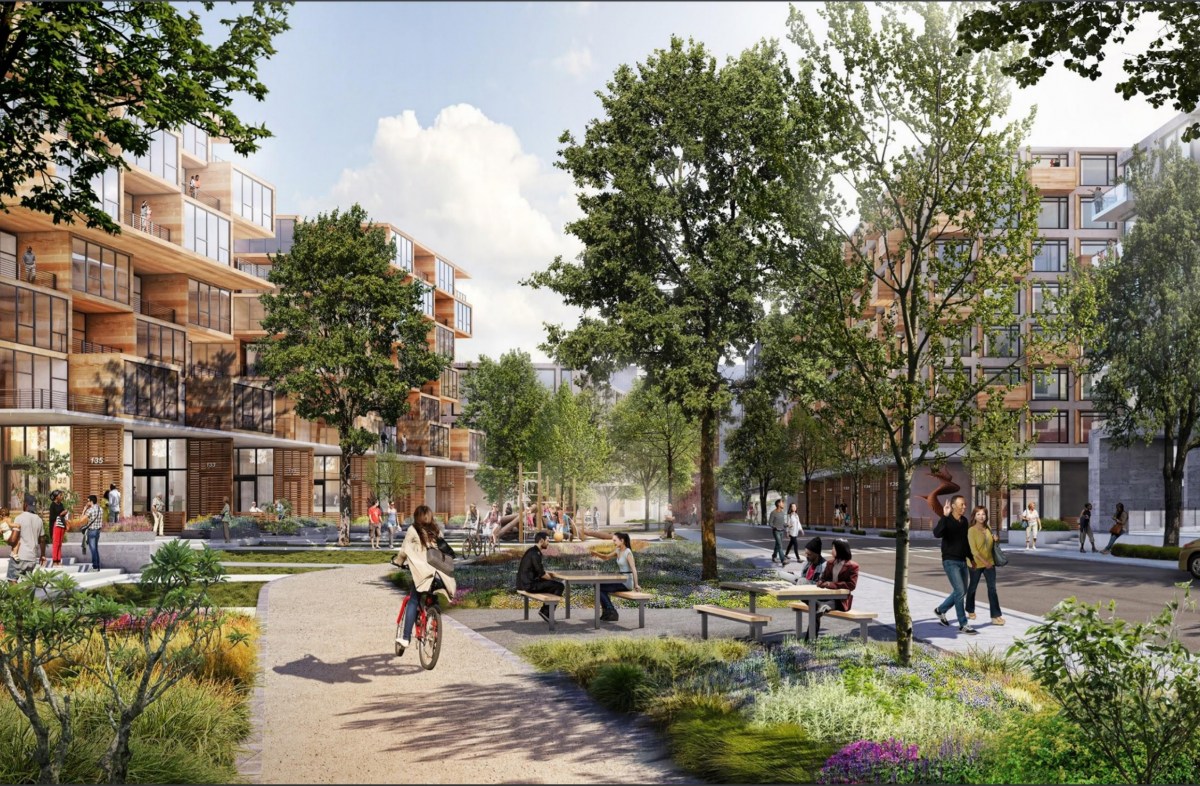
The Mountain View City Council gave its final stamp of approval Tuesday night on 7,000 new homes, 3 million square feet of office space and more than 26 acres of parks and open space that will be built out over the next 30 years in the city’s North Bayshore area.
Dubbed the North Bayshore Master Plan, the Google-led project’s unanimous approval from council at the June 13 meeting was a moment years in the making. It's the largest development ever approved in the city of Mountain View.
Before she cast her vote Tuesday night, Vice Mayor Pat Showalter recalled that one of the big campaign issues when she was running for council in 2014 was whether or not housing should be allowed in the North Bayshore area. Excluding the existing mobile home park in the area north of Highway 101, North Bayshore has largely been home to offices and commercial development.
The council agreed to change the precise plan in 2015 to allow residential development – a vision that’s just now beginning to come to fruition with Google’s project, which will transform North Bayshore from a suburban office park into a mixed-use, complete neighborhood. The zoning was formally amended in 2017.
“I thought it should be then, and I still think it should be,” Showalter said of allowing residential development in North Bayshore. “So I’m very excited that we’re at this point.”
Though the June 13 approval was unanimous, some council members raised concerns about the number of affordable homes coming out of the project, and whether the council was adequately consulted when that number of units was recently reduced.
When the plan was first introduced in 2021, developers Google and LendLease set a target for 1,400 of the project’s 7,000 homes to be affordable. Of those units, 1,050 would be built on land dedicated to the city, and the remaining 350 were proposed to be included among the plan’s market rate units.
But in a March 2023 version of the master plan, those 350 inclusionary units quietly disappeared from the project proposal. Google said at the time that it was no longer financially feasible for them to keep the extra affordable units in the project, and maintained that reasoning Tuesday night.
“We wish our discussions tonight were not impacted by the uncertainty of the economic climate,” said Michael Tymoff, Google's director of district development for Mountain View, at the June 13 meeting. “However, these are uncertain times, and the changes we’ve made are necessary to implement the master plan and achieve a balanced outcome. They are necessary to move forward with housing.”
At the request of the city’s Environmental Planning Commission, staff provided an estimated value of those units at the June 13 meeting. Staff said 350 inclusionary units would have been worth somewhere between $43 to $66 million to the city, depending on factors like the income level of residents and the unit mix.
Council member Lucas Ramirez said he would have liked to see the change come before the City Council for deliberation.
“That's tough for us to swallow as a council,” he said at the June 13 meeting. “I think it’s a policy decision and I think it’s appropriate for the council to at least have that discussion.”
However, council members were pleased to see that language was added to the development agreement to keep the door open for inclusionary affordable units to be added back to the project somewhere down the road. The agreement now states that the developer and city staff “agree to meet from time to time” to explore adding more affordable homes to the project – though doing would be entirely voluntary for the developers.
“This collaborative approach may include options whereby the city may identify alternative funding pathways, to facilitate the voluntary provision of such units into the project, to the extent financially feasible, at developer’s sole discretion,” the agreement now reads.
While the number of affordable homes was reduced to the bare minimum required under the precise plan, the project offers a community benefit package that goes above and beyond. Per the city’s rules, the project was subject to the minimum community benefit value of $42 million. To fulfill that, Google and LendLease are dedicating a 4.1 acre parcel of land to the city currently valued at $48 million. The city plans to use that land for a future elementary school site to help accommodate the large influx in students that the project will bring.
The project will also include nearly 15 acres of public parks; about 11 acres of privately owned, publicly accessible areas; and will contribute another $112 million of in-lieu fees to the city to meet its parkland requirements. The developers also revised the project’s "public benefits package" — separated from community benefits — to a value of $18.5 million, which will fund things like public art and activation programs for the project’s nearly 300,000 square feet of ground floor commercial space.
As for the concerns around affordable housing, council member Emily Ann Ramos said the city and the developers would “hold each other accountable for those promises, and see if we can make it through that finish line.”
“This is just a start,” she said. “This is a major milestone and I’m happy to be part of it.”
The project passed unanimously, a moment met with applause from members of the public in the audience.
“I’m very hopeful about this plan,” Mayor Alison Hicks remarked before casting her vote. “I know we have 30 years ahead of us, but I’m very positive about the transformation this will make.”
