
The city of Davis, California, built the first US bike lanes back in 1967 based on Dutch examples: "The city’s Public Works Department with the help of bicycle advocates and citizens, developed bike lane safety specifications and regulations that were adopted by Caltrans and copied across California and the United States."
Then-Governor Ronald Reagan signed bike lanes into California law, which became defined in Section 890.4. of the Streets and Highway Code. California and Caltrans define Bikeways as "all facilities that provide primarily for bicycle travel," and they came up with a few different classifications:
- Default: Shared Roadway (No Bikeway Designation). Most bicycle travel in the State now occurs on streets and highways without bikeway designations, and this may continue to be true in the future as well. (CA Highway Design Manual)
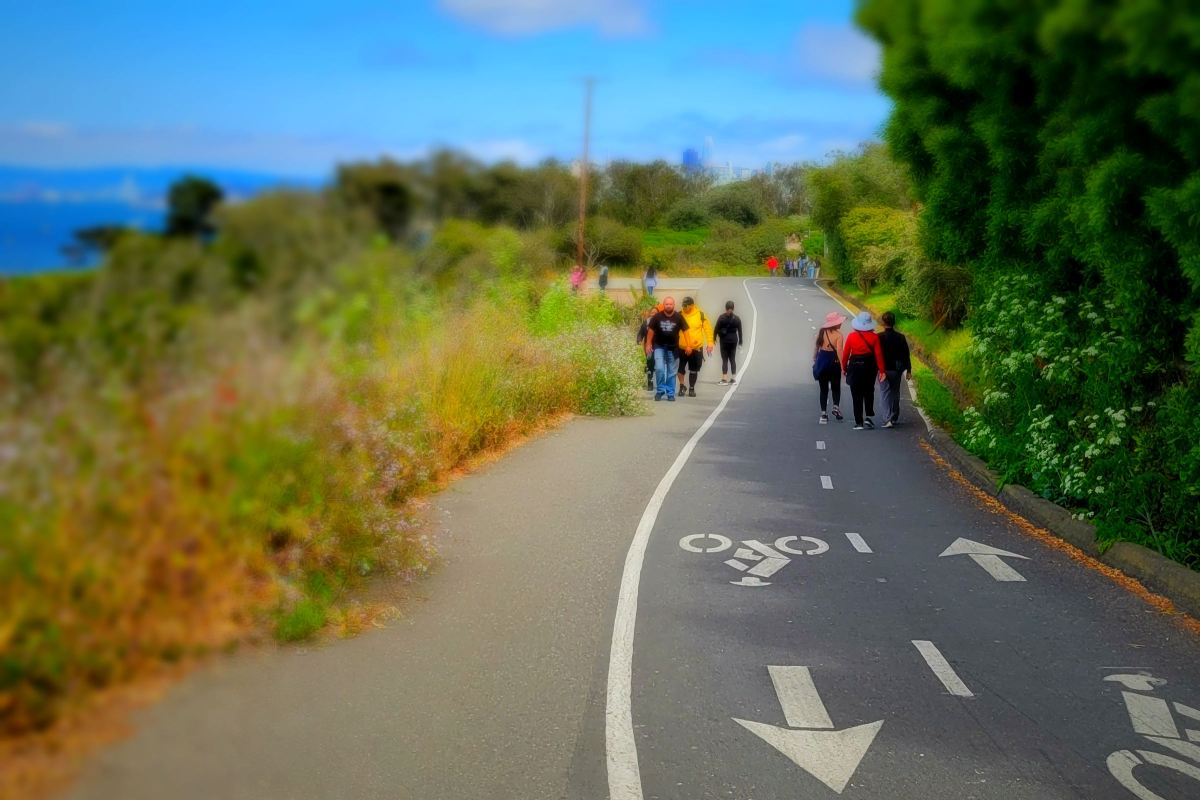
- Class I bikeways, such as a "bike path," provide a completely separated right-of-way designated for the exclusive use of bicycles and pedestrians, with crossflows by motorists minimized.
- Class II bikeways, such as a "bike lane," provide a restricted right-of-way designated for the exclusive or semi-exclusive use of bicycles with through travel by motor vehicles or pedestrians prohibited but with vehicle parking and crossflows by pedestrians and motorists permitted.
- Class III bikeways, such as an on-street or off-street "bike route," provide a right-of-way designated by signs or permanent markings and shared with pedestrians or motorists.
In summary, almost all streets are designated Shared Roadways until they become either a solid bike path (off-street) or a bike lane (on-street) and are primarily used for bicycle travel. Class III bike routes are really just a subcategory of Shared Roadways and as such should only be used in an emergency, so to speak. It should only be used when connecting bike lanes or bike paths but having to go through the rare narrow street. Locally, streets with no sidewalks and no parking lanes happen mostly in hilly, unincorporated areas like Emerald Hills. Most other streets around here are at least 28ft or 36ft wide, which is plenty of room to provide real bike lanes – if the street was needed as part of a larger transportation bicycle lane network.
Let The Bluffing Begin
Before we go any further, we need to quickly look into other realms where people move by different modes and speeds. If we simplify the fairly international Maritime Navigation Rules or the FIS rules of conduct used on the slopes, their rules make sure that the strongest is always in charge of safety. 'Strong' is based on features like speed, maneuverability, and line-of-sight. The strong looking out for the weak is such a great approach. We should apply it more on streets, roads and trails as well. Therefore, cars must look out for cyclists, and cyclists must look out for pedestrian safety. Speed kills. Speed is, therefore, in charge of safety. The speedy are, therefore, also to blame when things go sideways.
Bikeway Bluff – Class One

Class I Bikeways are supposed to be the best solution for people on bicycles. "Bicycle Highways" supposedly would fall into this category. But on most typical class I bikeways around here, the bicycle is NOT regarded as the primary or preferred mode of transportation. The moment bike paths are to be shared, the pedestrians and their speed become the deciding factor, and this bikeway basically becomes a trail. And while trails might be great for slow, recreational cycling, they aren't great for fast and transportation cycling. And yet, many Bay Area bike plans classify these trails as Class I bike paths.
The new Foster City waterfront could be regarded a real class I bikeway, but most others are closer to being class III off-street bike routes to be shared with pedestrians. For example, on the SF Bay Trail or the HMB Coastal Trail, the two modes can annoy each other quite a bit, especially when the fast cyclists don't look out for the slow walkers and vice versa. Case in point: Half Moon Bay and Palo Alto banned e-bikes on something they classified as a Class I Bikeway. These cities showed their hand, and we can call their bluff.
(HMB already called their own bluff; it turns out discriminatory e-bike bans are impossible to enforce).
Bikeway Bluff – Class Two

Class II Bikeways are "exclusive for bicycles … but with vehicle parking and crossflows by pedestrians and motorists permitted." – wait, what now? It is true California law seems to be unclear on this concept. Technically, the law seems to refer to Class I bikeways a lot and only sometimes mentions bike lanes but without clear classification. Often, the municipal code or police enforcement is the decisive factor in determining whether this bikeway is a bikeway or a parking lane.
Either way, we need a less bluffable law on this one.
Bikeway Bluff – Class Three
Almost no Class III bikeway in this area has any kind of "facilities primarily for bicycle travel." These bike routes generally don't give any safe space to cyclists, making them unsuitable for ADA, All-Ages-and-Abilities (AAA), and 8-80s. Bike routes are useless unless car volume is reduced and general speed is slower than 10mph. They are supposed to be used only as an exemption when there is really absolutely no space for Class II bike lanes. They are supposed to be used on very narrow streets and only for a few hundred feet. If you see a street that is wider than 20 feet featuring Cass III bike routes, you have been punked. The same is true if the "bike route" is more than a few hundred feet long; no driver can stomach staying behind cyclists any longer than that.
Many bike plans in San Mateo County are primarily based on these useless Class III bikeways. It's time to call this bluff.
Bikeway Bluff – Class Four
Bluff No. 4 brings us to The Protected Bikeways Act of 2014 (AB1193). This bill introduced California and the Caltrans design guidelines to a new version of the bike lane – the Separated or Protected Bikeway. It really could and should have been classified as a subcategory of Cass II, but instead, they gave it its own class. The bluff is in the numbering scheme. The uninformed might now think that since three is between two and four, class III is also between class II and IV when discussing quality and safety. Let's call that bluff and start considering class III as "class zero" – it certainly isn't part of Vision Zero.
Time To Re-Gift
You can be sure your city's Bicycle Master Plan is full of several of these Big Bikeway Bluffs. So on the twelfth day of Christmas, if your true love city gives to you …
- Twelve Sharrows drumming
- Eleven Bicycle Boulevards piping
- Ten Neighborhood Greenways leaping
- Nine Vehicular Cyclists dancing
- Eight Bikeable Walkways a-milking
- Seven Slow Streets a-swimming
- Six Walkable Sidewalks a-laying
- Five London Quietways
- Four Cycleways calling
- Three Dutch Woonerfs
- Two class Bike Lanes
- and a Partridge in a pear tree
Tell your city you would keep the cycleways, the woonerfs, the Class II Bike Lanes, and the partridge in a pear tree, but you should re-gift all the other shareways immediately.
Happy Holidays!

